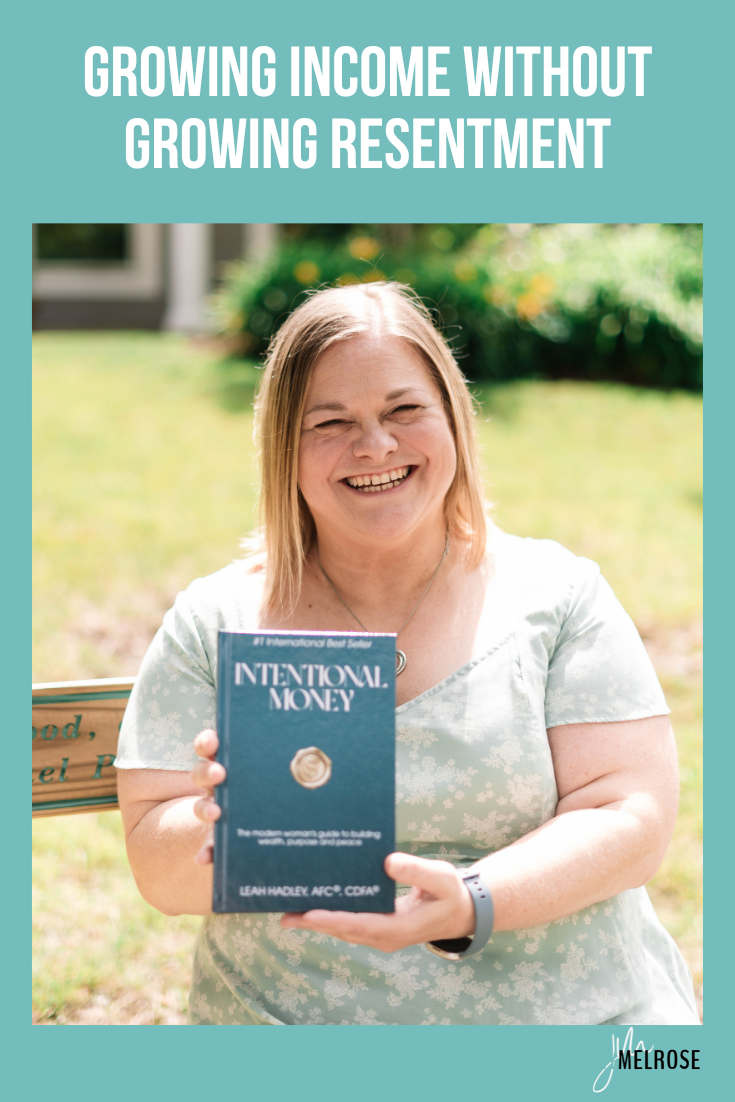
Learn how to grow your income without growing your workload, stress, or resentment by creating a business that supports both your financial goals and your life.
514: Growing Income without Growing Resentment with Leah Hadley
How can you grow your income without simply adding more clients, more work, and more responsibility? Leah Hadley shares how to think differently about growth, capacity, and intentional financial decisions so you can build a more profitable business without sacrificing your time, energy, or enjoyment of the work you love.
Leah Hadley is the Founder and CEO of Intentional Wealth Partners and Intentional Divorce Solutions, where she helps people navigate financial decisions during some of life’s biggest transitions.
With more than 20 years of experience in financial services, Leah specializes in the intersection of stress and money, supporting clients through transitions such as starting, growing, or exiting a business, divorce, and the loss of a loved one.
Having experienced divorce herself and rebuilt her life on her own terms, Leah brings a compassionate, judgment free approach to financial planning. She helps clients gain clarity, confidence, and control over their money so they can move forward with greater purpose and peace of mind.
What does more revenue actually require from a business owner?
Many business owners enter entrepreneurship because they are excellent at what they do, but they do not necessarily have a background in business. As a result, when they talk about earning more, they often focus on increasing revenue without considering what it will take to fulfill those additional sales.
Leah encourages business owners to look beyond revenue and pay attention to profitability and margins.
The goal is not simply to create a bigger sales number, but to determine how efficiently that revenue can be generated and how it ultimately contributes to personal wealth.
How can someone tell the difference between healthy ambition and chasing revenue at the expense of their own life?
For Leah, the answer begins with getting honest about what you actually want your business to look like.
When she first started her business after her divorce, she had three young children and needed to create enough income to support her family while still having the flexibility to be available for school events, appointments, and everyday life.
At the time, she did a significant amount of financial forensic work. The work was interesting and paid well, but the highly litigated cases were also energetically draining. Eventually, Leah realized that income alone was not enough to make the work sustainable.
What pays well isn’t always what gives you energy.
As she began shaping her business around the work that energized her, she discovered that sustainable growth could look different depending on the person.
For Leah, it meant serving fewer people in a more in depth way because that type of work was more fulfilling. For someone else, it might mean serving a larger number of people at a more surface level.
The key is knowing yourself well enough to understand what will be sustainable for you. Growth should fit the life you want to live, not require you to build a business that continually depletes you.
Why is the hustle mindset so difficult to break?
A lot of entrepreneurs believe that making more money means they need to work more. Most people are raised with the idea that getting results requires constant doing.
Leah believes that mindset can make it difficult for entrepreneurs to recognize another possibility: being intentional with wealth creation so that money can do some of the work for you.
That can mean strategically investing in the business, the team, yourself, or investments outside the business.
Leah encourages business owners to understand how money can make money rather than relying solely on their own time and effort to generate the next dollar.
For example, a rental property can generate income while the property itself increases in value. A dividend paying stock can provide ongoing income while the value of the stock grows. The same principle can be applied within a business.
In Leah’s wealth management practice, bringing on additional financial planners allows the business to generate additional profit without requiring her to personally handle all of the work.
The goal is to build assets and systems that can create value without everything depending on the owner’s time.
This also connects directly to capacity. Hiring someone to take over work that drains an entrepreneur’s energy can create space to focus on the parts of the business they actually enjoy and the activities that can increase revenue.
What are some of the hidden costs of growing income that business owners don’t think about until they’re already burned out or resentful?
One cost business owners sometimes overlook is taxes.
Leah points out that taxes are simply part of being successful, yet some entrepreneurs become so focused on avoiding them that they unconsciously limit their own growth.
Rather than allowing the fear of taxes to hold them back, she encourages business owners to understand how their income is taxed and look for strategic opportunities to minimize their tax burden while also being willing to own their success and accept that taxes come with it.
How does resentment show up when you’re constantly giving more to your business than you’re getting back?
Leah experienced this firsthand as an early business owner. She originally started her business so she could be available for her children, but eventually found herself taking on projects that were exhausting and draining her.
The revenue and even the profit were there, but the work wasn’t fueling her or feeling aligned with the kind of work she wanted to put into the world.
That experience taught her to look at her business in the context of her whole life, rather than evaluating success by revenue alone. About five years into her business, she began taking time at the end of each quarter to evaluate how she was showing up in different areas of her life, including her community, faith, family, and health.
The goal isn’t to maintain perfect balance all the time. Life changes, and the areas that need attention change with it.
Leah now uses this quarterly reflection to ask where she is, where she wants to put more energy in the coming season, and where she may need to make adjustments to feel more aligned with the life she wants to be living.
Success should be evaluated by more than what the business produces. It also matters what the business is producing in your life.
Why is it important for business owners to know their actual “enough” number?
Leah believes knowing your “enough” number can be incredibly empowering, especially in a business culture that constantly reinforces the idea that bigger is better.
She remembers sitting down and calculating how much she would actually need to accumulate and invest to comfortably live off her money for the rest of her life.
For Leah, discovering that number changed the way she viewed her business. Once she knew what she actually needed, she no longer felt the same pressure to continually grow. Instead, she had the freedom to choose the size of her business based on the impact she wanted to make and the life she wanted to live.
That number will look different for everyone. The question isn’t whether you should build a $200,000 business, a $2 million business, or a $20 million business. It’s what number makes sense for you?
How can business owners create financial systems that give them more freedom instead of another thing to manage?
Leah believes budgeting has gotten a bad reputation because many people associate it with restriction.
Instead, she sees a business budget and forecast as a roadmap that helps business owners understand what they expect to happen, evaluate what actually happens, and make informed adjustments along the way.
Rather than simply setting a goal of making $1 million, for example, business owners should determine what that number actually requires.
- How many clients would they need?
- How would those clients be served?
- Does the business have the team and capacity to support that level of service?
A financial plan isn’t meant to predict the future perfectly. It’s meant to give you a plan to adjust when the future doesn’t go according to plan.
Leah recommends creating a financial plan at least once a year and reviewing and updating it quarterly.
For her, staying close to the numbers is part of her work as a financial planner, but she believes every business owner can benefit from making this regular review part of their business rhythm.
Intentional Investing Guide
The Intentional Investing for Women Guide is a 24 page resource designed to help women feel more confident about investing.
It walks through how to think strategically about investing, determine an appropriate level of risk, evaluate existing investments such as old 401(k)s, and diversify beyond your business, all while aligning your investments with your goals, values, and the life you’re building.